Motor Tour: Biker's Challenge
- 3.6
- Rating
- 10.00M
- Installs
- Free
- Price

 Analysis by App-foxy
Motor Tour: Biker's Challenge gives me the feeling of stepping into a short, restless road trip rather than settling into a traditional racing campaign. The game puts a motorcycle on long highways, asks me to read traffic quickly, and keeps the action moving with a simple promise: survive the road, ride cleanly, and push forward. That focus makes it easy to understand within a few minutes, but it also means the experience depends heavily on whether I enjoy repeating compact bursts of traffic-dodging action.
Developed by Wolves Interactive ™️, this free racing game is aimed at players who want something immediate on Android rather than a deep motorcycle simulator. It is suitable for Everyone, runs on Android 7.0 or later, and has reached over 10 million installs. Those figures suggest that its basic pick-up-and-play design has found a broad audience, although the average rating of 3.6 from around 36 thousand ratings also hints that the straightforward formula will not satisfy every rider.
My first impression is positive when I treat it as a quick session game. I can start a ride without learning a complicated garage system or spending a long time preparing a race. The roads become the main stage, and the challenge comes from judging gaps, maintaining speed, and reacting before a harmless-looking traffic pattern turns into a crash. The best way to approach Motor Tour is as a focused reflex racer, not as a full motorcycle simulation.
You May Also Like

 Blood Strike: 2.5 Anniversary
Blood Strike’s Loadouts Turn Every Drop Into a Tactical Gamble
A close look at Blood Strike’s custom loadouts: how fast access to signature weapons reshapes its battle royale rhythm, rewards preparation, and narrows the gap between fights.

 Pandora - Music & Podcasts
Pandora’s Music Is Easy to Start, but Harder to Recover
Pandora’s strength is its low-effort path from a seed to a station. Its weak spot is how much confidence it asks you to place in connection, setup, and quiet recovery.

 8 Ball Pool
 Is Built on Rivalries, Rematches, and Routine
A close look at the rivalries, rematches, shared routines, and unanswered safety questions that turn a quick pool match into a persistent mobile community.

 Samsung Music
’s Quiet Strength Is Playing What You Already Own
Its reach comes less from spectacle than from dependable access to a personal library. That simplicity is both the app’s strongest retention engine and its ceiling.

 AccuWeather: Weather Radar
AccuWeather Review: A Quick, Clear Forecast for Everyday Decisions
For everyday plans, the best forecast is the one you can understand quickly. AccuWeather makes rain timing, radar, and local conditions easy to act on, with a few trade-offs.

 Hill Climb Racing
Why Hill Climb Racing Still Turns Crashes Into One More Run
A tiny car, a bumpy hill and one more upgrade: Hill Climb Racing keeps resurfacing because its simple chaos makes every near-miss feel personal.
More From Our News Desk



Why the first few rides feel approachable
The controls are built around the kind of decision-making that works well on a phone. I am not trying to reproduce every physical movement of a real motorcycle. Instead, I am watching the road, choosing a line, and making small adjustments while the scenery and traffic move toward me. That removes a lot of setup time and makes the game suitable for a spare moment when I want action rather than a long commitment.
This simplicity is also the source of the game's first important limitation. Players looking for detailed tuning, realistic handling, or the strategic depth of a large console-style racer may find the road structure too narrow. Motor Tour concentrates on the immediate ride. It does not appear designed to replace a serious driving game with extensive vehicle management, and I think it is better judged by the quality of its moment-to-moment flow.
The career modes give the experience more direction than an endless ride alone would provide. I like having a reason to return beyond simply trying to last longer. Progression makes individual runs feel connected, while the endless highway format keeps the basic challenge understandable. The combination works best when I use career play for structured goals and the open-ended road as a way to test my reactions without worrying about a final finish line.
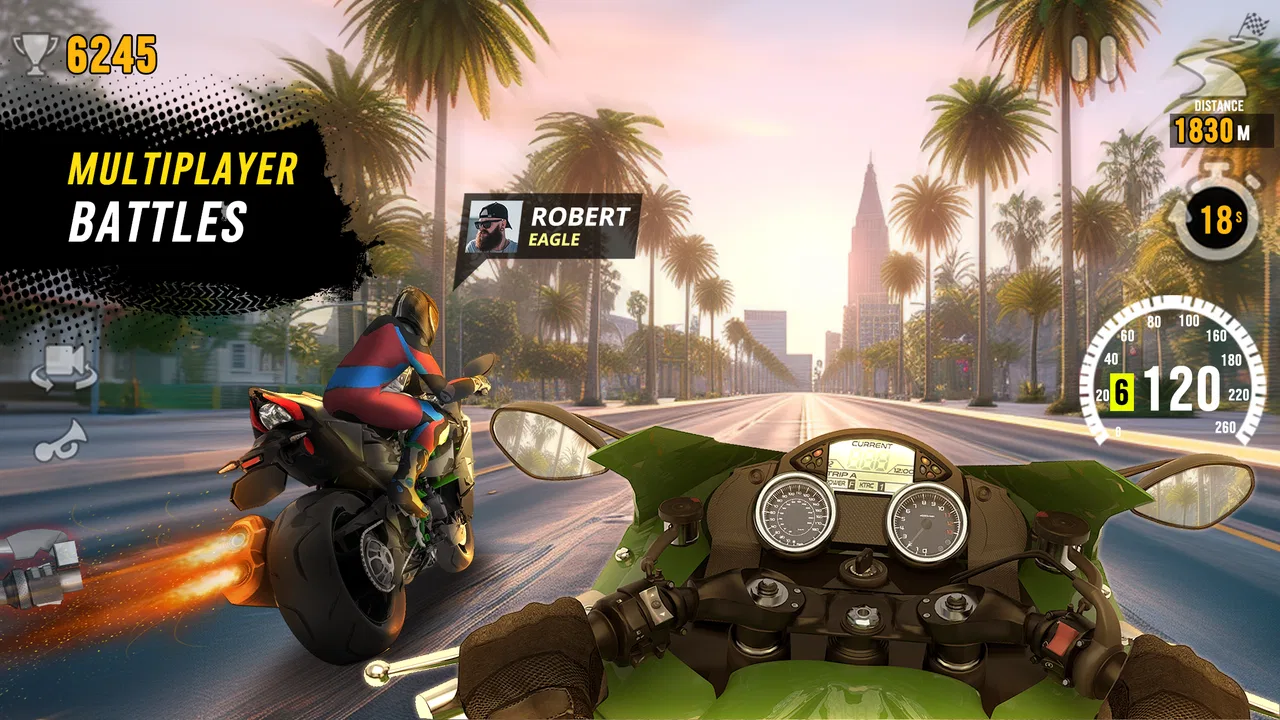
Real-time player-versus-player racing adds another layer for people who want competition beyond personal improvement. It changes the emotional tone of a session: a mistake feels more costly when I am comparing my performance with another person rather than only chasing my own result. At the same time, the appeal of this mode depends on how much I enjoy pressure. Someone who prefers a calm solo ride may find the competitive side less comfortable than the career experience.
A practical way to play during a busy day
A realistic use case is a short break between errands or during a commute when I have a few uninterrupted minutes. I can choose a career task, focus on one clean run, and stop without feeling that I have abandoned a long story. The game is especially convenient for this because its central activity is immediately readable: watch the highway, anticipate traffic, and avoid turning a good run into a sudden collision.
I recommend starting conservatively instead of chasing every possible opening. On a busy highway, a slightly slower line can be more valuable than an aggressive move that leaves no room to correct. I also find it useful to treat each ride as a lesson in traffic patterns. Rather than reacting only to the nearest vehicle, I look beyond it and plan the next two movements. That habit makes the game feel more controlled and helps reduce the frustration of late decisions.
Another useful approach is to separate practice from competition. Career play is a better place to become comfortable with the road's visual language, while real-time PvP is more enjoyable once I can make lane changes without hesitation. Entering competitive races too early can make the game seem harsher than it really is, because the problem may be unfamiliarity with the traffic flow rather than weak racing ability.
How the road, art direction, and setting work together
The setting is deliberately familiar: a motorcycle, a long highway, moving vehicles, and the sense that the road continues beyond the visible horizon. That choice gives the game a clear identity without requiring a complicated fictional world. I do not need a story explanation to understand the mood. The highway is both the track and the source of tension, and every passing vehicle becomes part of the scenery and the obstacle course at the same time.
What matters here is the way the visual language supports the mechanics. The road needs to remain legible while the scenery creates a feeling of speed. If the environment were too busy, I would struggle to distinguish decoration from danger. When the composition works, the highway markings, traffic, and open distance guide my attention naturally. I can enjoy the sense of travel while still keeping my eyes where they matter: on the next safe path.
The art direction also helps establish a particular kind of racing mood. This is not a polished track-day atmosphere built around grandstands and formal circuits. It feels more like an ongoing ride through public roads, where the challenge comes from sharing space and making decisions under pressure. That makes the game feel closer to an arcade road adventure than to a strict racing simulator.
I appreciate that the setting gives the pacing a reason to stay active. On a closed circuit, repeated laps can create a rhythm of corners and braking zones. Here, the road's apparent continuation encourages forward momentum. The experience is less about memorizing one perfect lap and more about preserving concentration as new traffic situations appear. That distinction is important when deciding whether this game suits you.
For me, the strongest visual quality is not any single background detail but the relationship between motion and readability. A good highway racer must make speed feel exciting without making every decision feel random. Motor Tour works best when I can understand why a maneuver succeeded or failed. If I choose a narrow gap and misjudge it, the result feels connected to my decision. That clarity is more valuable than decorative complexity.
Where the visual approach may not be enough
The same road-centered design can become repetitive for players who need constant environmental variety. Even with career goals and PvP, the core visual idea remains a motorcycle traveling along highways. I would not choose this as my main racing game if I wanted a large collection of distinct circuits, elaborate fictional locations, or a strong narrative campaign. A more expansive racing title would be a better fit for that kind of long-term visual discovery.
It is also worth remembering that visual atmosphere cannot replace mechanical variety. The highway creates tension, but the player still spends much of the time making related decisions about positioning and traffic. I enjoy that concentration in short sessions. Over longer stretches, I need to take breaks so the repeated pattern does not lose its impact. This is one reason I see the game as a companion for brief bursts rather than an all-evening commitment.
Sound, rhythm, and the feeling of speed
Sound has an important job in a game built around traffic timing. Even when I am focused on the road, audio helps reinforce the feeling that the motorcycle is moving through a living stream rather than sliding across a static track. The most effective sound design in this kind of experience does not need to dominate the screen; it needs to support acceleration, danger, and the release that comes after a close pass.
The rhythm of play comes from alternating attention and relief. I scan the road, make a quick decision, settle into a safe line for a moment, and then prepare for the next opening. That cycle gives the game a pulse that is easy to understand. The pacing is not built around long strategic pauses. It is built around maintaining a steady state of alertness, with occasional spikes when traffic closes the route.
This rhythm is also why I prefer playing with enough time to concentrate, even though the game is suitable for short sessions. A quick ride can fit neatly into a break, but the road still rewards uninterrupted attention. If I am constantly switching between tasks, I am more likely to make a careless move. The game does not require a long session; it does require that the short session be mentally present.
Real-time PvP changes the sound and pacing in a subtle way because the ride feels less private. In solo modes, I can use a failed run as practice and immediately think about what I would change. In competition, the same mistake carries a stronger emotional sting. That pressure can make close traffic encounters feel more dramatic, but it can also expose the game's simple structure if I am expecting a broad range of race strategies.
I find the sound-and-rhythm relationship most convincing when I let the road set my pace instead of forcing reckless speed. The temptation in a motorcycle game is to treat every gap as an invitation to accelerate. A better rhythm is to build consistency first, then take risks when the route clearly supports them. This makes the game less about frantic tapping and more about reading momentum.
Keeping the mood from turning into fatigue
My practical advice is to alternate modes rather than playing the same type of ride repeatedly. Career goals provide structure, endless highway play offers a personal endurance challenge, and PvP supplies competitive pressure. Moving between them gives the central road format different emotional purposes. It does not transform the game into a completely different racer, but it helps preserve the sense of progression and prevents every session from blending together.
I would also avoid judging the entire game from one difficult run. Traffic racing can make a small mistake feel disproportionately dramatic, especially when a ride has been going well. If I stop immediately after a frustrating crash, I may remember only the failure. Taking a short pause and returning with a more patient line usually gives me a clearer sense of whether the problem was the game or my own rushed decision.
How the mechanics support the atmosphere
Motor Tour's mechanics and mood are closely connected because the highway is not just a backdrop. The need to navigate moving traffic creates the atmosphere of risk, while the endless format keeps the player looking forward. Career modes add purpose, and PvP adds social pressure, but the central mechanic remains the same: maintain control while the road presents changing obstacles.
That focus makes the game easy to recommend to someone who likes arcade racing with a motorcycle theme. I can explain the appeal in one sentence without reducing it to a technical feature list: it is about keeping a fast ride alive through traffic while chasing progress or competition. The game does not ask me to learn a complicated simulation model before I can have fun.
It is less suitable for players who want the motorcycle itself to be the main object of study. If your enjoyment comes from adjusting suspension, comparing detailed handling characteristics, or mastering realistic track layouts, this will probably feel too streamlined. A dedicated motorcycle simulator or a larger racing game would offer more room for that kind of relationship with the vehicle.
The free entry point is helpful because I can try the core experience without paying upfront. However, in-app purchases range from $0.99 to $49.99 per item, so I would approach progression with a clear spending limit. The presence of optional purchases does not automatically ruin the game, but it does affect how I evaluate the long-term experience. I prefer to first decide whether the basic riding loop is enjoyable before considering any purchase.
That advice is particularly relevant for younger players, even though the content rating is Everyone. A family-friendly age rating describes the type of content, not whether every optional purchase is appropriate for every household. If a child is playing, I would use the device's purchase controls and agree on expectations beforehand. That keeps the focus on the racing rather than on accidental spending.
What progression means in practice
Career play is valuable because it turns individual rides into a sequence of objectives, but I would not expect it to provide the same breadth as a large campaign in a premium racing title. Its role is to give the highway structure and encourage repeated improvement. When I return to a task, I am usually trying to make a cleaner decision, survive longer, or handle traffic with less hesitation.
Endless play serves a different purpose. It is useful when I want to test concentration without the psychological pressure of completing a defined event. I can treat it as a personal training ground, using each attempt to improve my ability to look ahead. This is one of the game's less obvious strengths: the apparently simple format can reward deliberate practice if I stop treating every ride as a pure reaction test.
PvP is best for players who need an opponent to make racing feel meaningful. It adds urgency that solo modes cannot fully reproduce. Still, I would not choose the game solely for competitive depth. The core mechanics remain compact, so the appeal comes from the tension of performing under comparison rather than from a large strategic system. Someone seeking extensive online league features or a broad multiplayer ecosystem should look toward a more specialized racing game.
Who should download it and who should look elsewhere
I would recommend Motor Tour to a player who wants a free, accessible motorcycle racer that can be understood quickly and enjoyed in short sessions. It suits people who like traffic-dodging, forward motion, and the satisfaction of improving a run through better judgement. The career modes are useful for players who need goals, while real-time PvP gives competitive users a reason to stay engaged after the basic controls become familiar.
I would be more cautious about recommending it to someone who dislikes repetition or expects a detailed simulation. The game asks you to enjoy variations on a central highway challenge. If that loop feels compelling, the simplicity becomes a strength. If you need extensive vehicle customization, a story-driven world, realistic racecraft, or a large range of track types, the same simplicity will feel restrictive.
It also may not be the best choice for someone who wants a relaxing ride. The setting can suggest freedom, but the mechanics demand attention. Traffic turns the open road into a test of timing, and PvP can raise the pressure further. For a calmer experience, a casual driving game with less collision risk would probably be more comfortable.
On the other hand, players who enjoy learning through repetition may get more from it than the first few minutes suggest. The useful skill is not simply faster reactions. It is the ability to read the whole traffic picture, preserve an escape route, and resist a tempting but unsafe opening. That is where the game gains a little depth beyond its straightforward presentation.
My final take on the playable mood
Motor Tour: Biker's Challenge succeeds when its art direction, highway setting, sound, and pacing all point toward the same feeling: a fast ride where concentration matters. The world is not trying to tell a large story. It creates a clear road-focused mood, then lets traffic and momentum provide the drama. I find that coherence more valuable than a long list of features that would distract from the central ride.
The game is currently at version 2.3.1, and its free format makes it easy to test without a financial commitment at the start. I would spend time with career play first, use endless rides to practice looking ahead, and only then decide whether real-time PvP adds the kind of pressure I enjoy. That order gives the mechanics a fair chance before competition or optional purchases influence my opinion.
My honest recommendation is therefore specific: choose this if you want an approachable motorcycle racing game built around highway traffic, quick decisions, and repeatable sessions. Skip it if your priority is simulation depth, extensive customization, or a constantly changing racing world. For the right player, the narrow focus is exactly what makes the game work. It creates a compact, energetic mood and gives every successful pass a small but satisfying sense of control.
With an average rating of 3.6, the mixed reception feels understandable to me. The game has a clear identity, but that identity leaves little room for players who want something outside its road-racing loop. I enjoy it most when I treat each ride as a focused challenge rather than expecting a complete motorcycle lifestyle. In that role, it is a convenient free racer from Wolves Interactive ™️ that can turn a few spare minutes into a tense, fast-moving ride.
FAQs for Motor Tour: Biker's Challenge
01What is Motor Tour: Biker's Challenge?
Motor Tour: Biker's Challenge is a motorcycle racing game focused on fast-paced traffic riding, lane changes, and completing challenges on busy roads. During testing, the main appeal was its pick-up-and-play design: you can quickly start a ride, avoid vehicles, collect rewards, and improve your bike. It is aimed at players who enjoy arcade-style driving rather than realistic motorcycle simulation.
02Can I play Motor Tour: Biker's Challenge offline?
The game appears suitable for casual offline play in its core riding modes, which is useful when you do not have a stable internet connection. However, some features may still require connectivity, including advertisements, online rewards, updates, or other server-dependent content. Availability can also vary by device and version, so it is best to launch the game once while connected before relying on it during travel.
03Does Motor Tour: Biker's Challenge contain advertisements or in-app purchases?
Yes, players should expect advertising and possible optional purchases, as is common with free-to-download mobile racing games. Ads may appear between attempts or when claiming bonus rewards, while purchases can potentially speed up progression or provide additional resources. You can enjoy the basic gameplay without spending money, but patience may be necessary if you prefer not to watch ads or buy upgrades.
04Is Motor Tour: Biker's Challenge suitable for children?
The game is generally easy to understand because its controls and objectives are straightforward, making it accessible to younger players. Nevertheless, parents should check the age rating shown in their local app store and review the advertising and purchase settings before allowing unsupervised play. The fast traffic, crashes, and competitive challenge structure may also be more appropriate for children who already enjoy arcade racing games.
05What devices are required to run Motor Tour: Biker's Challenge smoothly?
Motor Tour: Biker's Challenge is designed for modern Android and iOS smartphones and tablets, but performance can differ depending on hardware, operating-system version, available storage, and background applications. Devices with limited memory may experience slower loading, frame-rate drops, or occasional instability. Before downloading, check the official store listing for the current compatibility requirements and keep enough free space available for installation and updates.
Pros
- Responsive controls make steering easy to learn.
- Bike upgrades add useful progression between races.
- Short events work well for quick gaming sessions.
- Different environments keep the scenery from feeling repetitive.
- Offline play is convenient when an internet connection is unavailable.
Cons
- Some upgrades may require considerable time or repeated races.
- Traffic and obstacles can feel unpredictable during fast runs.
- The game may become repetitive after mastering the main routes.
- Ads can interrupt progression or appear between activities.
- Performance may vary on older phones with limited hardware.

Motor Tour: Biker's Challenge
Gallery